

Blog 3: Load Management
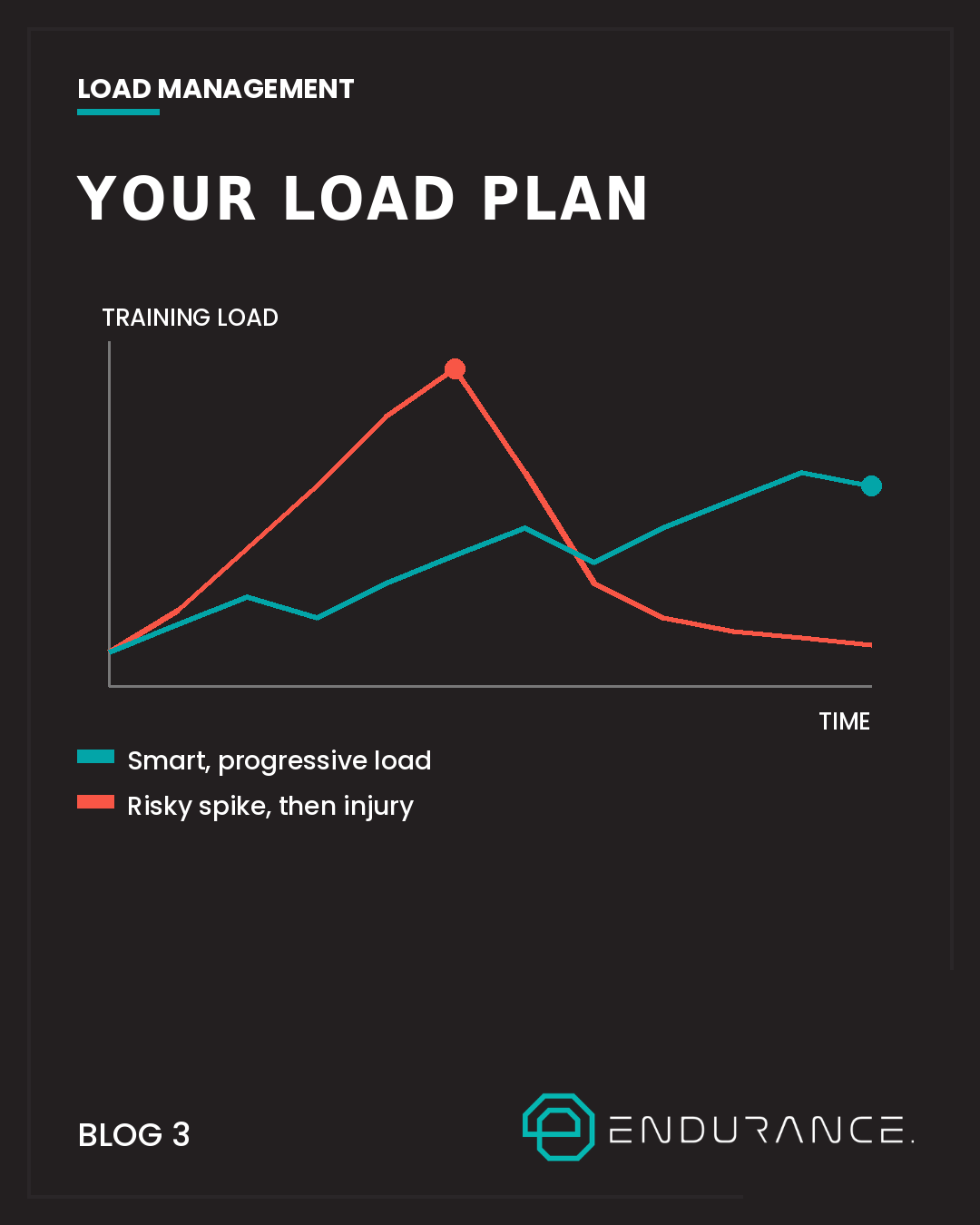
Part 3: Building a Load Management Plan That Actually Works
Welcome to the final part of Load Management. Part 1 established what training load actually is and why load spikes rather than load itself cause most athletic injuries. Part 2 covered the physical and psychological signals that tell you load has exceeded recovery. Part 3 is where it becomes practical; the tools, habits, and frameworks that let you train consistently, build fitness progressively, and stay healthy while doing it.
The goal of this series has never been to train less. It has been to train smarter. The athletes who manage their load well do not train less than those who do not. They get more out of every session because their body is actually in a position to adapt.
The 10% Rule: Simple, Evidence-Based, and Chronically Ignored
The 10% rule is the most widely cited load management guideline in endurance sport: do not increase your total weekly training volume by more than 10% from one week to the next. It applies to running kilometres, cycling hours, swimming metres, and total training load across all sports.
The reason it works is rooted in tissue adaptation timelines. Cardiovascular fitness adapts relatively quickly to new training demands. Tendons, ligaments, bones, and cartilage adapt significantly more slowly. The 10% rule creates a ceiling that keeps training progression within the adaptation capacity of the slower-responding tissues. Violate it consistently and those tissues accumulate micro-damage faster than they can repair it.
Practical applications:
If you ran 40 kilometres last week, your ceiling for this week is 44 kilometres
If you are returning from two weeks off due to illness, do not go back to your pre-illness volume immediately. Start at 60 to 70% and rebuild from there.
If you are adding a new type of training: speed work, hill sessions, strength training, treat it as additional volume load even if the total time looks manageable
During race build phases, apply the rule to both volume and intensity separately. Ramping both simultaneously is how athletes arrive at the start line injured.
The Deload Week: The Training Week Most Athletes Skip
A deload week is a planned reduction in training volume and intensity, typically every third or fourth week of a training block. Volume is reduced by 20 to 30% and intensity is kept moderate. The point is not rest, it is structured recovery that allows the body to consolidate the adaptations that have been accumulating across the previous weeks.
Research on periodization consistently shows that athletes who include deload weeks in their training blocks improve more over a season than those who train at consistent high load without planned recovery periods. The deload week is not a sign of weakness. It is where fitness is actually built.
What a deload week looks like in practice:
Total volume drops by 20 to 30% compared to the previous week
Session intensity is reduced: easy efforts stay easy, no new hard sessions are added
Activation work, mobility, and soft tissue maintenance are maintained or increased
Sleep and recovery are prioritized: this is the week to get ahead on rest
The week after a deload should feel noticeably fresher and more powerful: if it does not, the previous training block was too much
Thinking About Total Load: Not Just Training Load
This is the piece that most training plans miss entirely. A training plan manages training load. Your body is managing total load — which includes everything the nervous system is processing simultaneously.
A practical framework for thinking about total load:
High training load weeks should coincide with lower life stress where possible: this is not always controllable but it is worth thinking about when scheduling race builds and heavy training blocks
When life stress is unavoidably high: exam periods, demanding work projects, family demands — reduce training load proactively rather than reactively. Waiting until the body breaks is always more costly.
Sleep debt is a load multiplier: each hour of sleep below your optimal amount increases the physiological cost of the same training session. Six hours of sleep does not equal eight hours with a training load adjustment. It is a different body doing the same work.
Travel, time zone changes, and environmental factors all contribute to total load in ways that rarely appear in training plans but reliably show up in injury risk
Practical Load Management for Different Athlete Types
The framework adapts slightly based on the athlete:
For endurance athletes (runners, triathletes, cyclists):
Structure your week with one hard session, one medium session, and the rest genuinely easy
Protect the run load most conservatively — it creates the highest impact stress of any endurance discipline
Build deload weeks into every race build as non-negotiable, not optional
After any race of significance, give the body two weeks of easy activity before beginning the next build
For youth and multi-sport athletes:
Count all sport activity toward total load: school sport, club sport, rep teams, and gym sessions all contribute
Track total weekly session count across all sports, not just one team's training volume
Growth periods require additional load conservatism: bone and connective tissue are under particular stress during rapid growth phases
One sport off-season per year is protective, not optional: the research on reduced injury rates in athletes who take multi-month breaks from a single sport is consistent and compelling
For masters athletes (35 and over):
Recovery windows between hard sessions extend with age: what required 24 hours of recovery at 25 may require 48 to 72 hours at 50
Strength training twice per week is not supplementary at this stage: it is foundational to maintaining the tissue capacity that training demands
Deload frequency increases: consider deloading every third week rather than every fourth
Be honest about seasonal volume ceilings: the annual volume that is sustainable at 50 is different from what was sustainable at 35, and that is not failure, it is physiology
When the Plan Meets Reality
Every training plan is built on assumptions that will not all hold true. Illness, travel, work demands, family responsibilities, and unexpected life events will interrupt even the most thoughtfully built programme. The question is not whether disruptions will happen. It is how you respond to them.
The most damaging response is to try to make up for lost time. The athlete who misses a week due to illness and then doubles their following week to compensate is not making up for lost fitness. They are creating a load spike that their deconditioned tissue is entirely unprepared for. The fitness loss from a week of reduced training is modest and recoverable. The injury risk from the compensatory spike is not.
The most protective response is to treat disruptions as resets. Start back at 60 to 70% of your previous load and rebuild from there. Accept that the timeline has shifted. The body responds to what you actually do, not to what you planned to do.
A Final Note
Load management is not glamorous. It does not have the appeal of a new training method or a performance-enhancing intervention. But across every sport, at every level, in every research context I am aware of, the athletes who manage their load intelligently are the ones who train the most consistently, improve the most reliably, and stay healthy the longest.
More is not always better. The right amount, at the right time, with adequate recovery, that is the formula. It sounds simple because it is. The difficulty is in having the discipline to follow it when the impulse to do more is strong.
Train more by doing less. It works.
______
If load management is the missing piece in your training, or if you are in a recurring injury cycle that you cannot seem to break, I work with athletes at every level and every sport to build training approaches that actually hold together. Reach out to book a consultation at Endurance Therapeutics.
📍 Endurance Therapeutics | Oakville