

Blog 1: Stretching vs. Mobility: Why One Feels Good, One Makes You Better
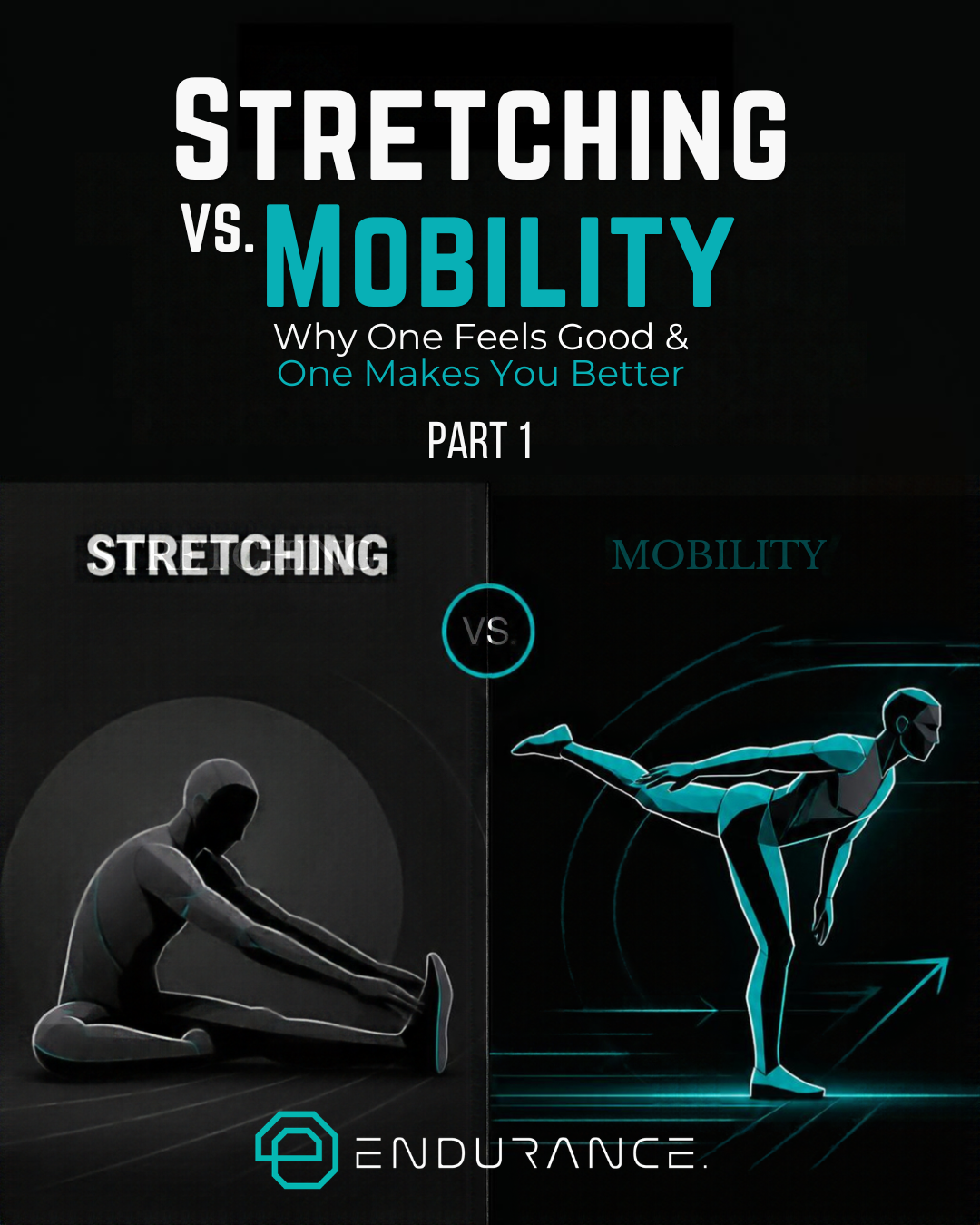
Part 1: What's the Difference and Why It Matters
Hi, I’m Dr. Keirstyn founder, chiropractor and coach at Endurance Therapeutics! Welcome to this 5 part series which will educate you on the differences of stretching and mobility in relation to endurance sport.
If you've spent any time in the endurance world, you've been told to stretch. Stretch before you run. Stretch after you ride. Stretch when something hurts. Stretch when nothing hurts. Stretching has been drilled into athletes as the universal fix for tightness, injury prevention, and performance.
The problem? Stretching alone doesn't fix most of the movement restrictions that endurance athletes deal with. It feels good in the moment, but it doesn't create lasting change, and it doesn't address the root cause of why you feel tight in the first place.
What most athletes actually need isn't more stretching. It's more mobility.
Stretching and mobility aren't the same thing, and understanding the difference changes how you approach your body, your training, and your injury prevention work. Let's break it down.
What Stretching Actually Is
Stretching is passive lengthening of a muscle. You pull a muscle to its end range, hold it there, and wait for the tissue to relax. Static stretching, dynamic stretching, PNF stretching, they all share the same goal: increase the length of a muscle or muscle group so you can move through a bigger range.
Stretching has its place:
It feels good after a hard session
It can reduce acute muscle tension
It can be part of a cool-down routine that helps you mentally transition out of training mode
But here's what stretching doesn't do: it doesn't teach your body how to control that new range. It doesn't improve the strength, stability, or coordination required to actually use the flexibility you just gained. And if your nervous system doesn't trust that you can control a range of motion, it won't let you access it when it matters.
That's why you can stretch your hamstrings every day and still feel tight when you run. That's why your hips feel loose on the foam roller but locked up during your stride. Passive flexibility without active control isn't functional movement.
What Mobility Actually Is
Mobility is your ability to actively control a joint through its full range of motion. It's not just about how far a muscle can lengthen. It's about how well you can move through that range with strength, stability, and coordination.
Mobility requires three things:
Flexibility (the passive range)
Strength at end range (the ability to control that range)
Motor control (the coordination to access it when you need it)
When you have true mobility, your body trusts the range. Your nervous system knows you can handle it. You can move fluidly, absorb force efficiently, and access the positions your sport demands without compensation.
For endurance athletes, mobility is what allows you to:
Maintain good running mechanics when you're fatigued
Hold an aerodynamic position on the bike without your lower back taking over
Keep your shoulders healthy through thousands of swim strokes
Stretching gives you temporary length. Mobility gives you usable, durable movement.
Why Your Body Feels Tight (And Why Stretching Doesn't Always Fix It)
Tightness isn't always a muscle length problem. Most of the time, it's a nervous system problem.
Your brain controls how much range of motion you can access, and it makes that decision based on one question: can you control this range safely?
If your nervous system doesn't trust that you have the strength, stability, or coordination to move through a range of motion, it will restrict that range to protect you. That restriction feels like tightness, but stretching it doesn't solve the problem because the issue isn't the muscle. The issue is the lack of control.
This is why:
Runners stretch their hip flexors religiously and still feel tight
Cyclists foam roll their quads and still have restricted knee extension
Swimmers stretch their lats and still can't get full overhead range
The tightness isn't the problem. It's the symptom.
Your body is restricting range because it doesn't have the strength or stability to handle more. Stretching might give you a few degrees of temporary relief, but unless you build control at that new range, your nervous system will pull it back the next time you move.
Mobility work fixes this because it teaches your body that the range is safe. It builds strength at end range. It improves motor control. It gives your nervous system permission to let go.
The Difference in Practice
Here's what the difference looks like in real movement.
Passive hamstring stretch: you sit on the ground, reach for your toes, and hold. You're lengthening the hamstring, but you're not teaching it how to control that length or how to fire properly through your gait cycle.
Active mobility drill for the hamstrings: single-leg Romanian deadlift, controlled tempo, full range. You're moving the hamstring through flexion and extension under load. You're building strength at end range. You're teaching your body how to control the movement it will need when you run.
Passive hip flexor stretch: kneeling lunge, hips forward, hold. You're lengthening the hip flexor, but you're not addressing the posterior chain weakness or the lack of hip extension control that's causing the tightness in the first place.
Active hip mobility drill: hip CARs (controlled articular rotations), moving the hip through its full range in all planes, slow and controlled. You're teaching the hip how to move, not just how to lengthen.
Stretching isn't bad. It's just incomplete. Mobility is what makes the flexibility you gain actually usable.
What This Means for Endurance Athletes
Endurance athletes live in repetitive movement patterns. Thousands of strides. Thousands of pedal strokes. Thousands of swim strokes. Your body adapts to those patterns, and over time, you lose range in the directions you don't use.
Runners lose hip extension because the stride never fully opens
Cyclists lose thoracic extension because they spend hours in flexion
Swimmers lose shoulder internal rotation because of the volume of overhead work
Stretching those restrictions might feel good, but it doesn't restore the movement quality you need to stay healthy. Mobility work does.
Mobility work teaches:
Your hips how to extend under load
Your thoracic spine how to rotate without compensating through your lower back
Your shoulders how to move through full range without impingement
It's not about being more flexible. It's about being more capable.
What Comes Next
Stretching has been sold as the solution to tightness for decades, but the truth is more nuanced. Passive flexibility without active control doesn't protect you. It doesn't improve your movement. And it doesn't fix the restrictions that are actually driving your pain.
In Part 2, we're going to break down why stretching alone doesn't fix your tightness, what your nervous system has to do with it, and why you need strength at end range to actually create lasting change.
If you've been stretching the same areas for months and still feel tight, book your session at Endurance Therapeutics today to identify what's actually restricting your movement and build a plan that creates lasting change.
📍 Endurance Therapeutics | Oakville, Ontario
📞 905-288-7161