

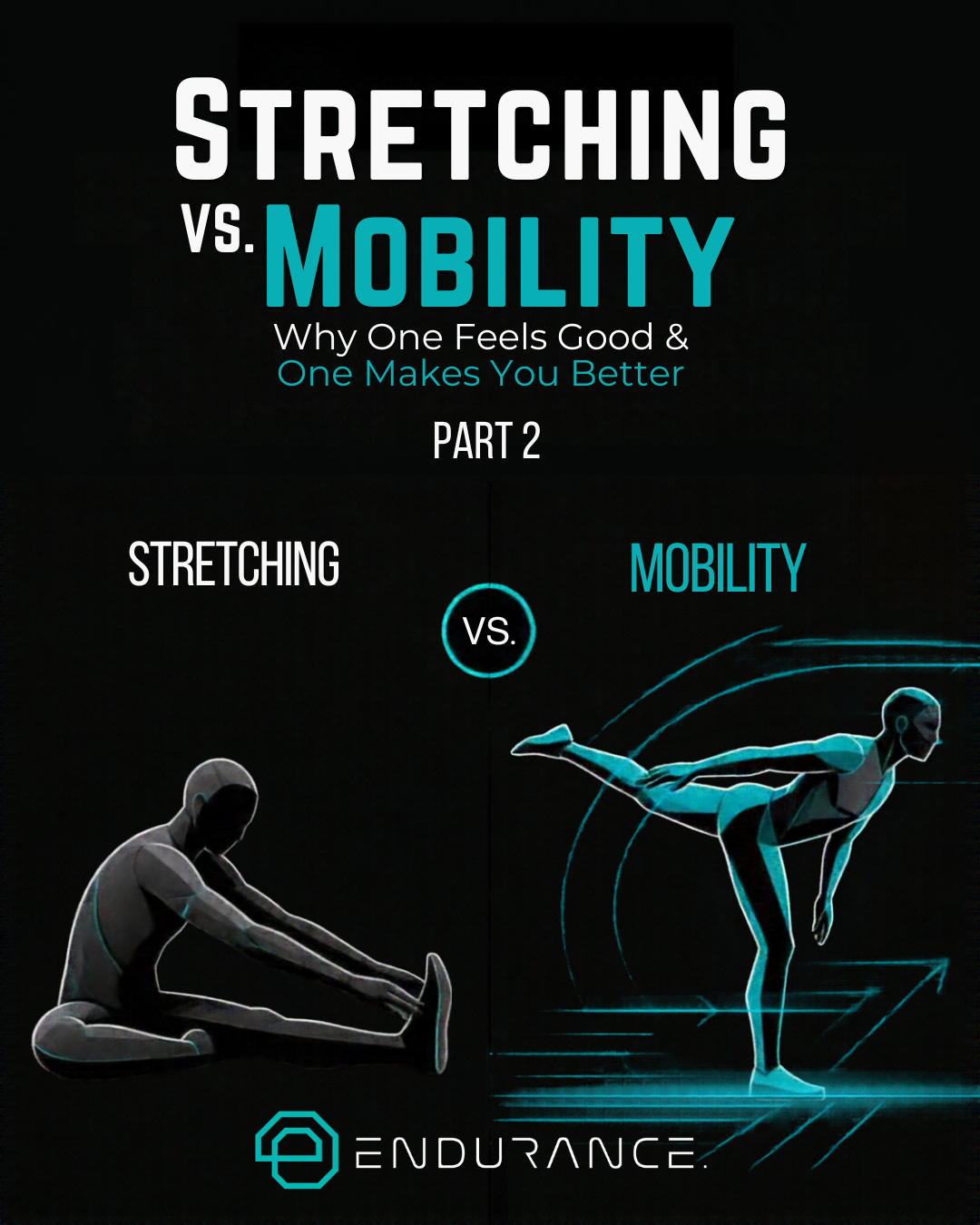
Part 2: Why Stretching Alone Doesn't Fix Your Tightness
Hi, I'm Dr. Keirstyn, founder, chiropractor and coach at Endurance Therapeutics. In Part 1, we broke down the difference between stretching and mobility. Now we're going to dig into why stretching alone doesn't fix the tightness you keep feeling.
Why Stretching Feels Good but Doesn't Stick
Stretching feels good because it temporarily reduces tension in a muscle. You pull a muscle to its end range, hold it there, and your nervous system responds by relaxing the tissue. For a few minutes, maybe a few hours, you feel looser.
But that relief doesn't last because stretching doesn't address the reason your body was restricting range in the first place.
Your nervous system controls how much range of motion you can access, and it makes that decision based on one question: can you control this range safely?
If your nervous system doesn't trust that you have the strength, stability, or coordination to move through a range of motion, it will restrict that range to protect you. That restriction feels like tightness, but the tightness isn't the problem. It's the symptom.
Stretching gives you temporary length, but it doesn't teach your body how to control that length. It doesn't build strength at end range. It doesn't improve motor control. And without those pieces, your nervous system pulls the range back the next time you move.
That's why you can stretch your hip flexors every day and still feel tight when you run. That's why your hamstrings feel loose after foam rolling but locked up during your stride. Passive flexibility without active control isn't functional movement.
Your Nervous System Is the Gatekeeper
Your brain doesn't care how flexible you are. It cares how safe you are.
Every time you move, your nervous system is running a risk assessment. It's asking: do I have the strength, stability, and coordination to handle this range of motion? If the answer is no, it restricts the range to protect you from injury.
This is why:
Runners stretch their hip flexors religiously and still feel tight (because the hip flexors are compensating for weak glutes and poor hip extension control)
Cyclists foam roll their quads and still have restricted knee extension (because the quads are overworking to stabilize a hip that isn't doing its job)
Swimmers stretch their lats and still can't get full overhead range (because the shoulder doesn't have the rotator cuff strength to control that range under load)
The tightness you feel isn't a muscle length problem. It's a control problem.
Your body is restricting range because it doesn't have the strength or stability to handle more. Stretching might give you a few degrees of temporary relief, but unless you build control at that new range, your nervous system will pull it back the next time you move.
Stretching Without Strength Is Just Temporary Length
Here's what happens when you stretch without building strength at end range:
You stretch your hamstrings and gain a few degrees of passive flexibility
Your nervous system registers that new range but doesn't trust it because you haven't trained the strength or coordination to control it
The next time you run, your nervous system restricts the range again to protect you
You feel tight again, so you stretch again, and the cycle repeats
Stretching without strength is like trying to increase your credit limit without increasing your income. You might get approved temporarily, but the system will pull it back the moment it realizes you can't handle it.
Mobility work breaks that cycle because it teaches your body that the range is safe. It builds strength at end range. It improves motor control. It gives your nervous system permission to let go.
What You Actually Need: Strength at End Range
If you want to create lasting change in your range of motion, you need to build strength at the ranges you're trying to access.
Strength at end range means you can control a joint through its full range of motion under load. It means your body trusts that you can handle the range, so your nervous system stops restricting it.
Here's what that looks like in practice:
Hamstring tightness: instead of sitting on the ground and reaching for your toes, do single leg Romanian deadlifts with a controlled tempo. You're moving the hamstring through flexion and extension under load. You're building strength at end range. You're teaching your body how to control the movement it will need when you run.
Hip flexor tightness: instead of kneeling lunges, do split squats with a focus on hip extension at the top. You're teaching your hip how to extend under load, which is what it needs to do when you run. You're addressing the posterior chain weakness that's causing the tightness in the first place.
Shoulder tightness: instead of static lat stretches, do controlled shoulder CARs (controlled articular rotations) or banded pull aparts. You're moving the shoulder through its full range in all planes, slow and controlled. You're teaching the shoulder how to move, not just how to lengthen.
Stretching gives you temporary length. Strength at end range gives you usable, durable movement.
Why Endurance Athletes Need This More Than Anyone
Endurance athletes live in repetitive movement patterns. Thousands of strides. Thousands of pedal strokes. Thousands of swim strokes. Your body adapts to those patterns, and over time, you lose range in the directions you don't use.
Runners lose hip extension because the stride never fully opens
Cyclists lose thoracic extension because they spend hours in flexion
Swimmers lose shoulder internal rotation because of the volume of overhead work
Stretching those restrictions might feel good, but it doesn't restore the movement quality you need to stay healthy. Mobility work does.
Mobility work teaches:
Your hips how to extend under load
Your thoracic spine how to rotate without compensating through your lower back
Your shoulders how to move through full range without impingement
It's not about being more flexible. It's about being more capable.
What Comes Next
Stretching has been sold as the solution to tightness for decades, but the truth is more nuanced. Passive flexibility without active control doesn't protect you. It doesn't improve your movement. And it doesn't fix the restrictions that are actually driving your pain.
In Part 3, we're going to break down the specific mobility drills that endurance athletes need, how to program them into your training, and how to build strength at the ranges that matter most for your sport.
If you've been stretching the same areas for months and still feel tight, book your session at Endurance Therapeutics today to identify what's actually restricting your movement and build a plan that creates lasting change.
📍 Endurance Therapeutics | Oakville, Ontario
📞 905-288-7161