

Blog 10: The Overuse Injuries Playbook
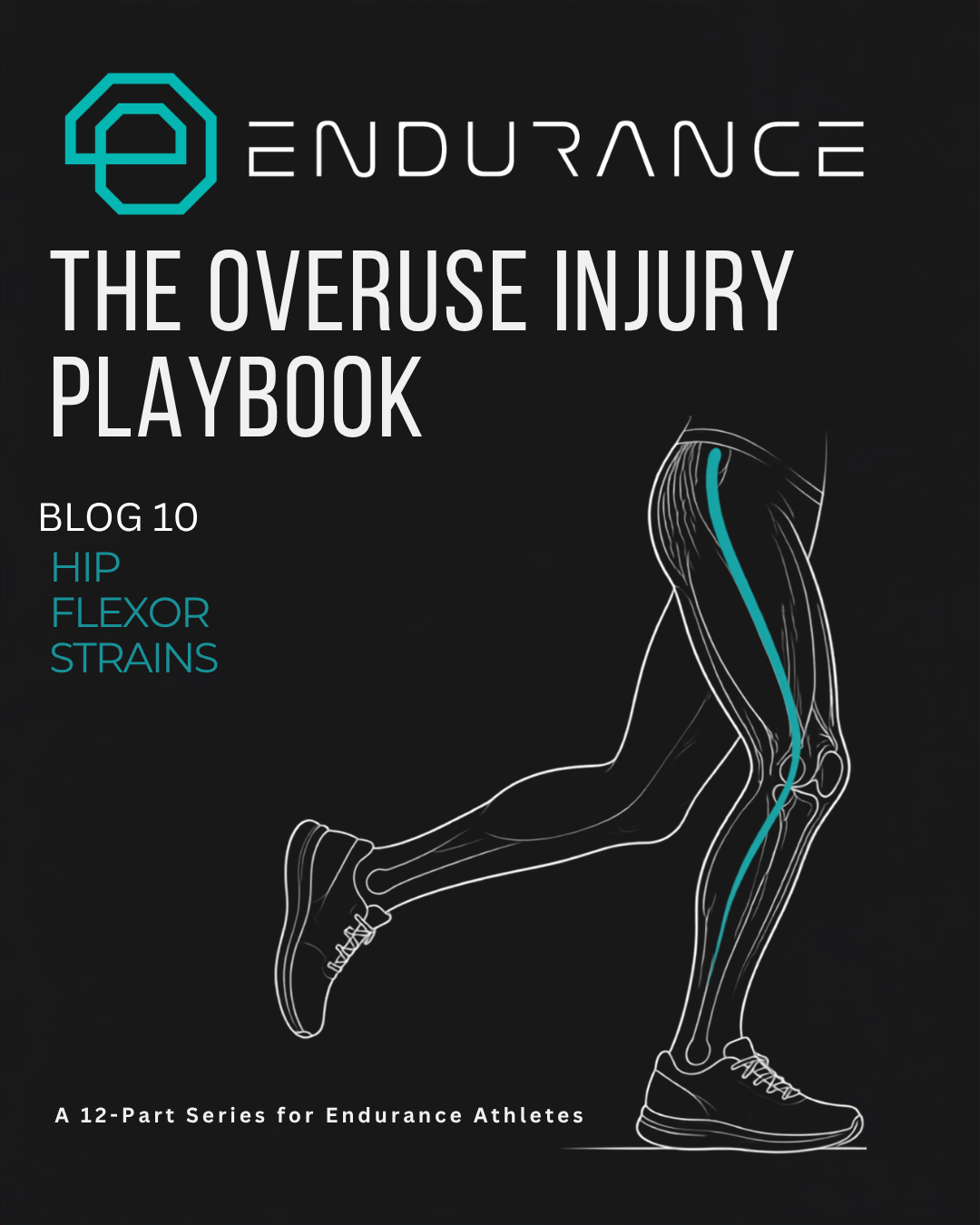
Part 10: Hip Flexor Strains: Why Your Front Hip Hurts and How to Fix It
Welcome back to The Overuse Injury Playbook. I'm Dr. Keirstyn, a chiropractor and endurance coach. In this series, we are breaking down the most common injuries that sideline athletes. In Part 1, we covered plantar fasciitis, in Part 2, we tackled Achilles tendinopathy, in Part 3, we broke down shin splints, in Part 4, we looked at runner's knee, in Part 5, we covered IT band syndrome, in Part 6, we looked at meniscus injuries, and in Part 7, we covered stress fractures, and in Part 8, we looked at high hamstring tendinopathy in Part 8, we looked at high hamstring tendinopathy, and in Part 9, we covered groin and adductor strains. Today, we are diving into the tight, nagging pain at the front of your hip that cuts your stride short: hip flexor strains.
It starts as a dull ache in the crease of your hip during a run. At first, you only notice it when you lift your knee high, like running uphill or climbing stairs. But as the weeks go on, the ache becomes sharper. Soon, it hurts to get out of a chair, and you feel a pinch every time you try to accelerate.
This is a hip flexor strain, and it is one of the most common overuse injuries in endurance athletes. Left untreated, it leads to compensations that affect your entire kinetic chain.
What a Hip Flexor Strain Actually Is
Your hip flexors are a group of muscles at the front of your hip responsible for lifting your knee toward your chest. The primary muscle involved is the iliopsoas, which connects your lower spine and pelvis to your femur.
A hip flexor strain occurs when these muscles are overworked, overstretched, or forced to contract while already in a lengthened position. In runners, this is rarely a sudden tear. It is usually a gradual overuse injury caused by repetitive hip flexion combined with poor pelvic mechanics.
Why Your Hip Flexor Is Overworking
Hip flexor pain is rarely just about the hip flexor itself. It is usually a sign of weakness and instability elsewhere in the chain.
Weak Glutes: If your glutes are not driving hip extension properly, your hip flexors have to work overtime on the opposite leg to pull your knee forward with every stride.
Anterior Pelvic Tilt: If your pelvis tilts forward, your hip flexors are placed in a chronically shortened position, making them tight and prone to strain.
Overstriding: Landing with your foot too far in front of your body forces your hip flexor to work harder to pull your leg through the next stride.
Sudden Increases in Speed or Hill Work: Speed intervals and hill repeats require aggressive hip flexion, which can quickly overload a hip flexor that is not prepared for the demand.
How to Actually Fix Hip Flexor Strains
To heal a hip flexor strain, we must reduce the irritation and build the strength and stability your hips need to handle the load.
Manage the Load: Avoid activities that cause sharp pain in the front of your hip. This means cutting out speed work, hill repeats, and high knee drills for a while. Keep your runs flat and at an easy pace. If running is too painful, swap it for swimming or flat road cycling.
Build Glute Strength: Your glutes are the counterbalance to your hip flexors. Use the Glute Bridge to build hip extension strength and take the load off your hip flexors.
Improve Pelvic Stability: Incorporate the Modified Plank and Modified Dead Bug to build core control and teach your pelvis to stay neutral during movement.
Strengthen in a Functional Pattern: The Single Leg Deadlift is an excellent exercise to build single leg stability while teaching your hips to move through a full range of motion without compensation.
Manual Therapy: In the clinic, I use soft tissue therapy and joint mobilizations to restore proper movement to your hips and lower back, ensuring your pelvis is moving efficiently.
Final Word
A hip flexor strain is a sign that your pelvic mechanics and glute strength need attention. By addressing the root cause, you can get back to running with a full, powerful stride.
Up next in Part 11, we will look at lower back pain, the deep ache that makes every mile feel harder than it should.
Struggling with front hip pain or tightness that limits your stride? Book an assessment with me, Dr. Keirstyn, at Endurance Therapeutics. Let's find the root cause and build a plan to get you back to training pain free.
📍 Endurance Therapeutics | Oakville, Ontario
📞 905-288-7161