

Blog 4: The Overuse Injuries Playbook
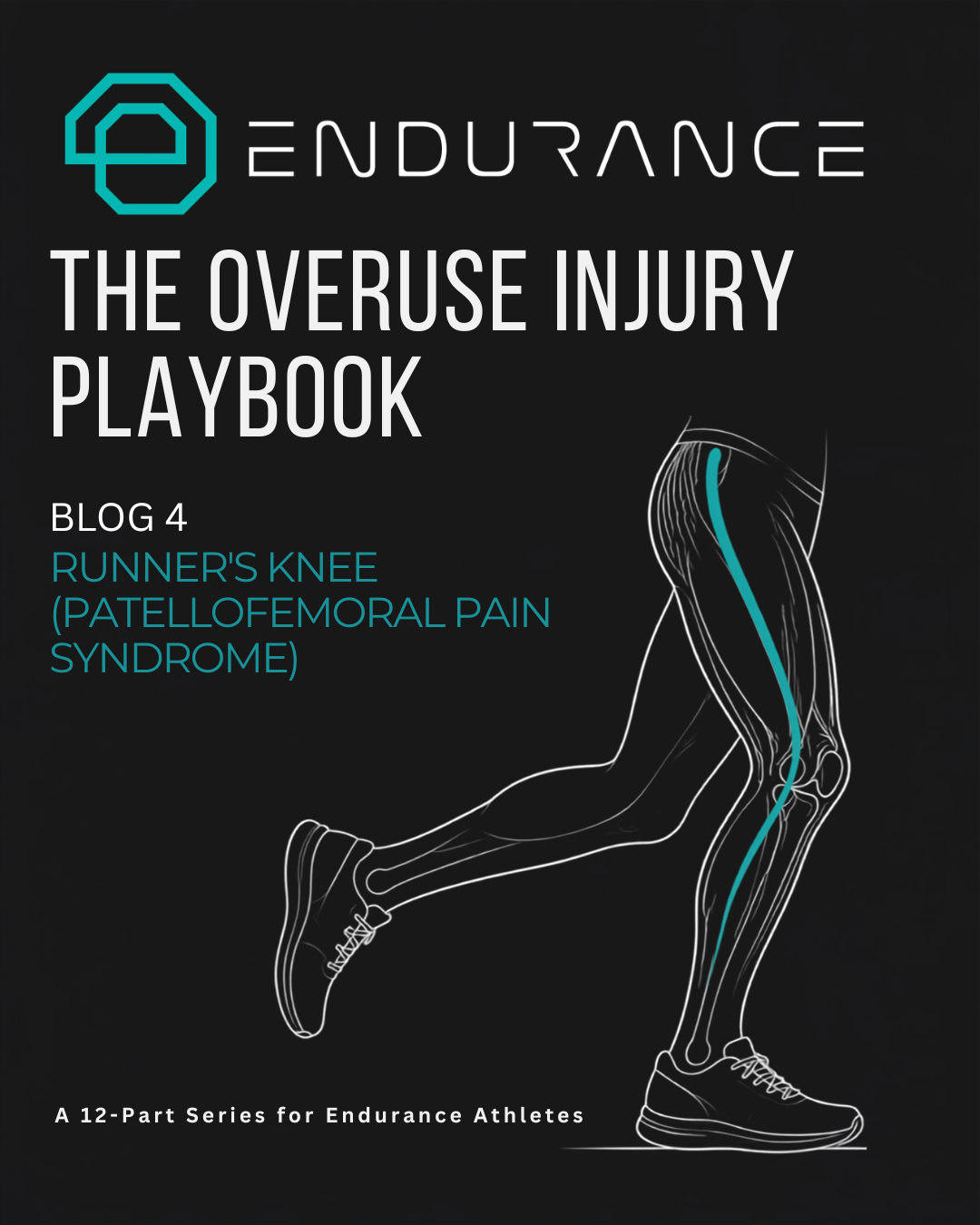
Part 4: Runner's Knee (Patellofemoral Pain Syndrome): Why the Front of Your Knee Hurts and What Actually Fixes It
Welcome back to The Overuse Injury Playbook. I'm Dr. Keirstyn, a chiropractor, endurance athlete and coach. In this series, we are breaking down the most common injuries that sideline athletes. In Part 1, we covered plantar fasciitis, in Part 2, we tackled Achilles tendinopathy, and in Part 3, we broke down shin splints. Today, we are looking at the most common culprit of front knee pain: runner's knee.
You are halfway through a long run when a dull ache starts creeping in right under or around your kneecap. It is not excruciating at first, but it is persistent. By the time you finish, walking down a flight of stairs feels like a cruel punishment.
In the clinic, I often tell my patients that if your knee hurts on the run, the knee may only be the messenger. The knee is caught in the middle of whatever is happening at your hip and your foot. When those areas are not doing their job, the knee absorbs the force.
What Runner's Knee Actually Is
Patellofemoral pain syndrome is the clinical term for runner's knee. It is irritation where the underside of your kneecap meets your thigh bone.
Instead of tracking smoothly in its groove, the kneecap gets pulled slightly off course. This creates friction, inflammation, and that familiar ache. The pain is typically worse when running downhill, sitting for long periods, or walking down stairs.
Why Your Knee Is Taking the Hit
Runner's knee is rarely a knee problem. It is a tracking problem caused by imbalances above and below the joint. Here are the main reasons your kneecap is pulling off course:
Weak Glutes and Hips: If your glutes cannot control your thigh bone, your knee caves inward with every stride. This poor alignment forces the kneecap to track incorrectly.
Tight Quads and Hips: Tightness in your quadriceps pulls upward on the kneecap, increasing pressure in the joint. Tightness in the posterior chain also limits your movement.
Overstriding: Landing with your foot too far in front of your body sends a massive braking force straight into your knee joint.
Sudden Training Jumps: Adding too many hills or ramping up your weekly volume too quickly stresses the joint before the surrounding muscles can adapt.
How to Actually Fix Runner's Knee
To fix this, we have to stop chasing the pain and start addressing the mechanics.
Manage the Load: Reduce your running volume to a level that does not trigger pain during or after your run. Swap some running sessions for cycling or swimming to keep your aerobic fitness high.
Activate Your Glutes: Building hip stability is non-negotiable. Incorporate the Glute Bridge and the Hip Hike into your routine to teach your body to control pelvic drop and keep your knee aligned.
Strengthen the Inner Quads: The Modified Copenhagen exercise is excellent for targeting the VMO (the tear-shaped muscle on the inside of your knee), your adductors, and your glutes. This helps pull the kneecap back into its proper groove.
Release Tight Areas: Use the Figure 4 Stretch to target tight areas in your hips, and use the Goalie Stretch and Quad Stretch to release tension around the knee joint itself.
Manual Therapy: In the clinic, I use myofascial release therapy and joint mobilizations to restore proper movement to your hips and ankles. This takes the pressure off the knee and allows the surrounding tissues to heal.
Final Word
Do not let runner's knee linger until you are forced to stop running entirely. By focusing on hip strength, tissue mobility, and proper training progression, you can get your kneecap tracking smoothly again.
Up next in Part 5, we will dive into IT band syndrome: the sharp pain on the outside of your knee that ruins your long runs.
Struggling with knee pain on your runs or finding it painful to walk down stairs? Book an assessment with me, Dr. Keirstyn, at Endurance Therapeutics. Let's find the root cause of your knee pain and build a plan to get you back to training without limitations.
📍 Endurance Therapeutics | Oakville, Ontario
📞 905-288-7161