

Blog 5: The Overuse Injuries Playbook
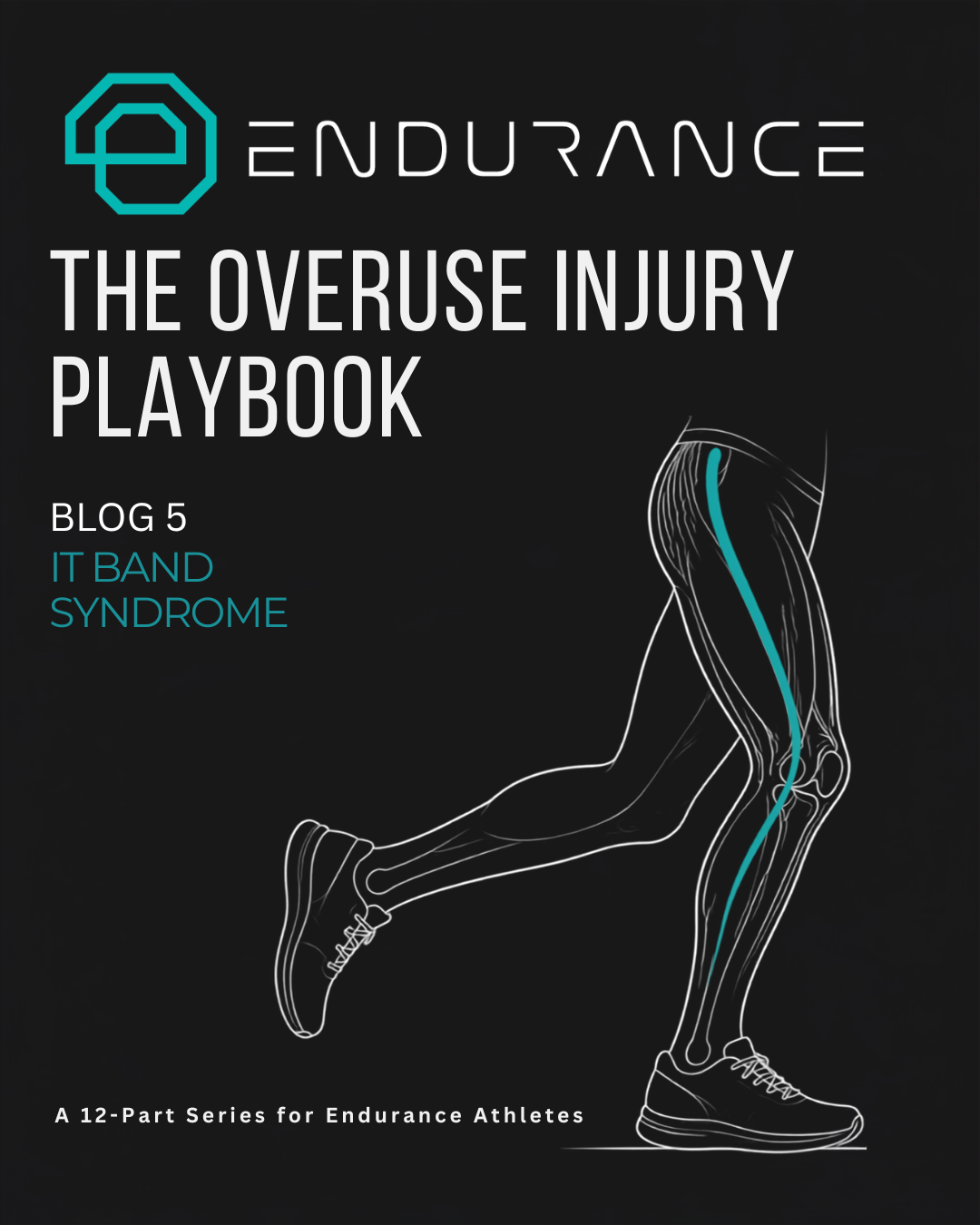
Part 5: IT Band Syndrome: Why the Outside of Your Knee Hurts and What Actually Fixes It
Welcome back to The Overuse Injury Playbook. I'm Dr. Keirstyn, a chiropractor and endurance coach. In this series, we're breaking down the most common injuries that sideline athletes. In Part 1, we covered plantar fasciitis, in Part 2, we tackled Achilles tendinopathy, in Part 3, we broke down shin splints, and in Part 4, we looked at runner's knee. Today, we're diving into a frustrating pain that stops runners right in their tracks: IT band syndrome.
You start your run feeling great. Your pace is on target, your breathing is easy, and you're settling into a rhythm. Then, around mile four, a sharp, burning pain flares up on the outside of your knee. It feels like someone is driving a nail into the side of your joint. You try to push through, but within a few minutes, the pain is so intense that you're forced to walk, limping your way back home.
This is the classic presentation of Iliotibial Band Syndrome. It's incredibly frustrating because it often feels completely fine when you're walking or resting, only to flare up at the exact same mileage mark on every single run.
What IT Band Syndrome Actually Is
Your iliotibial (IT) band is a thick, fibrous band of connective tissue that runs down the outside of your thigh, starting at your hip and inserting just below your knee. It acts as a stabilizer for your knee and hip during movement.
The old theory was that a tight IT band rubs back and forth over the bony bump on the outside of your knee, causing friction. We now know it's actually a compression issue. When your leg moves through a specific angle (usually around 30 degrees of knee flexion), the IT band compresses the highly sensitive, fat-rich tissue underneath it. If your mechanics are off, this compression happens repeatedly, leading to severe irritation and pain.
Why Your IT Band Is Compressing
Because the IT band is a thick, non-elastic structure, you can't simply stretch your way out of this problem. You've got to look at why the band is being pulled so tight against your knee. The root cause is almost always found at the hip.
Weak Hip Abductors: Your gluteus medius is responsible for keeping your pelvis level when you stand on one leg. If this muscle is weak, your hip drops and your thigh bone rotates inward with every step. This inward collapse puts immense tension on the IT band, pulling it tight against the outside of your knee.
Crossover Gait: If you run as if you're on a tightrope, with your feet crossing over your body's midline, you place a massive lateral strain on the IT band. We can detect this in our gait analysis in an initial assessment.
Running on Crowned Roads: Consistently running on the sloped side of a road forces one hip to tilt, mimicking a leg-length discrepancy and overloading the IT band on the downhill side.
Downhill Running: Running downhill increases the amount of time your knee spends in that 30-degree flexion zone, which is the exact angle where maximum compression occurs.
How to Actually Fix IT Band Syndrome
To fix this, we've got to stop trying to stretch the IT band itself. It's as strong as a car tire. Instead, we need to strengthen the muscles that control your hip and pelvis.
Manage the Load: Avoid the activities that trigger the sharp pain. If you can run three miles pain-free but it flares up at mile four, keep your runs to two and a half miles for now. Swap your long runs for cycling or swimming to maintain your aerobic base.
Build Hip Stability: This is the most important step. You've got to strengthen your hip abductors and glutes. Incorporate the Hip Hike to build pelvic control, and use Fire Hydrants to target your hip rotators.
Strengthen the Entire Chain: The Single Leg Deadlift is an excellent functional exercise for runners. It forces your glutes, hamstrings, and core to work together to stabilize your entire leg while you balance.
Release the Surrounding Tissues: While you can't stretch the IT band, you can release the muscles that pull on it, specifically your glutes and your tensor fasciae latae (TFL). Use the [Pigeon] stretch or the Figure 4 Stretch to reduce tension in your glutes and hips.
Manual Therapy: In the clinic, I use myofascial release therapy and dynamic cupping to address tension in the TFL, glutes, and quadriceps. We also look at your running gait to see if a crossover stride or pelvic drop is contributing to the compression.
Final Word
IT band syndrome isn't a death sentence for your running season, but it does require a shift in focus. Stop rolling your IT band with a foam roller (which only compresses the irritated tissue further) and start building the hip strength you need to keep your knee aligned.
Up next in Part 6, we'll look at high hamstring tendinopathy: the deep ache in your glute that makes speed work feel impossible.
Struggling with sharp pain on the outside of your knee or finding that your runs are cut short at the exact same mileage every time? Book an assessment with me, Dr. Keirstyn, at Endurance Therapeutics. Let's find the root cause of your IT band compression and build a plan to get you back to training without limitations.
📍 Endurance Therapeutics | Oakville, Ontario
📞 905-288-7161