

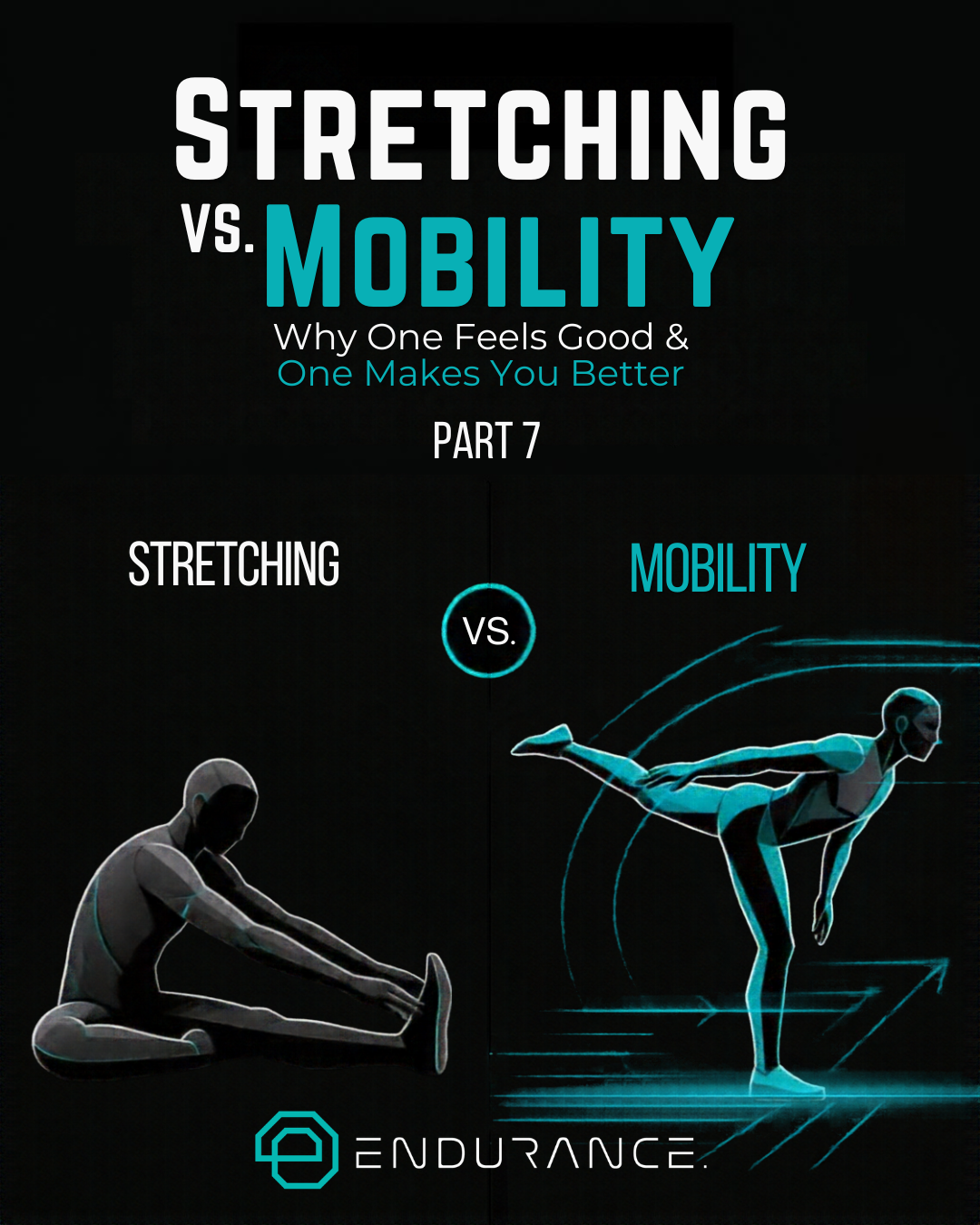
Part 7: Putting It All Together: Programming Mobility Into Your Training
Hi, I'm Dr. Keirstyn, founder, chiropractor and endurance coach at Endurance Therapeutics. In Blog 6, we walked through how to assess your own mobility and build a personalized plan. But here's the thing: a plan only works if you actually do it.
Most athletes know they need to work on mobility. They know their hips are tight, their ankles don't move well, and their thoracic spine is stuck. But they don't do the work because they don't know where to fit it into their training, they don't know how much is enough, and they don't know how to balance it with their strength training and sport-specific work.
In this final part, we're putting it all together. We're breaking down how to program mobility work into your training schedule, how to balance it with everything else you're doing, and how to make it sustainable long term.
Why Most Athletes Don't Stick With Mobility Work
Most athletes don't stick with mobility work because they treat it like an extra. They think of it as something they should do if they have time, not something that's part of their training.
That's the problem.
Mobility work isn't an extra. It's part of your training. It's what keeps you healthy, reduces your injury risk, and allows you to keep training consistently. If you're not doing mobility work, you're not training smart.
Here's why most athletes don't stick with it:
They don't know where to fit it in: They think mobility work needs to be a separate session, and they don't have time for that.
They don't know how much is enough: They think they need to spend an hour on it, and that feels overwhelming.
They don't see results fast enough: Mobility takes time, and most athletes give up before they see progress.
The solution is simple: make mobility work part of your training, not something separate. Build it into your warm up, your cool down, or your strength training. Keep it short and consistent. And give it time.
How to Program Mobility Work Into Your Training
Mobility work doesn't need to take an hour. It needs to be consistent.
Here's how to fit it into your training:
Daily: CARs (5 to 10 minutes)
Controlled Articular Rotations (CARs) are the foundation of mobility work. They teach your nervous system that a range of motion is safe, and they build motor control at end range.
CARs should be done daily, as part of your warm up. Pick 2 to 3 joints that match your biggest restrictions (hips, ankles, thoracic spine, shoulders), and spend 5 to 10 minutes moving through them slowly and controlled.
Example:
Hip CARs: 5 reps per side
Ankle CARs: 5 reps per side
Thoracic CARs: 5 reps
That's it. 5 to 10 minutes, every day, before your training.
2 to 3 Times Per Week: Strength-Based Mobility Drills (10 to 15 minutes)
Strength-based mobility drills build strength at end range. They teach your body that a range of motion is not only safe, but usable.
These drills should be done 2 to 3 times per week, as part of your strength training or cool down. Pick 2 to 3 drills that match your biggest restrictions, and spend 10 to 15 minutes on them.
Example for runners, cyclists, swimmers, and triathletes:
90/90 Hip Stretch with Lift Off: 3 sets of 5 reps per side
Single Leg Calf Raises (Eccentric Focus): 3 sets of 8 reps per side
Thoracic Extensions on Foam Roller: 3 sets of 5 breaths
Example for court and field athletes (pickleball, padel, tennis, soccer):
Cossack Squats: 3 sets of 8 reps per side
Lateral Lunges with a Pause: 3 sets of 8 reps per side
Thoracic Rotations in Half Kneeling: 3 sets of 8 reps per side
Example for hockey players:
Hip Flexor Stretch with Posterior Pelvic Tilt: 3 sets of 30 seconds per side
Copenhagen Planks: 3 sets of 20 seconds per side
Wall Angels: 3 sets of 10 reps
That's 10 to 15 minutes, 2 to 3 times per week, as part of your strength training or cool down.
How to Balance Mobility Work With Strength Training and Sport-Specific Work
Mobility work doesn't replace strength training or sport-specific work. It supports it.
Here's how to balance it:
Mobility work comes first.
Mobility work should be done before your strength training or sport-specific work, not after. If you wait until the end of your session, you'll be too tired to do it well, and you'll skip it.
CARs should be part of your warm up. Strength-based mobility drills should be part of your strength training, either as a warm up or as accessory work between sets.
Mobility work doesn't need to be a separate session.
You don't need to set aside an hour for mobility work. You need to build it into what you're already doing.
Daily CARs: 5 to 10 minutes, part of your warm up
Strength-based mobility drills: 10 to 15 minutes, 2 to 3 times per week, part of your strength training or cool down
That's it. You're not adding hours to your training. You're making what you're already doing more effective.
Mobility work supports your strength training and sport-specific work.
Mobility work isn't just about injury prevention. It's about performance. When you have better range of motion and better motor control, you move better. You generate more power. You're more efficient. And you stay healthy.
If you're a runner and you improve your hip extension, your stride gets longer and more powerful. If you're a hockey player and you improve your thoracic extension, your shot gets stronger and your shoulder stays healthier. If you're a pickleball player and you improve your hip internal rotation, you move laterally more efficiently and your knees stay healthier.
Mobility work makes everything else you do better.
How Long Does It Take to See Results?
Mobility takes time. You're not going to see dramatic changes in a week. But you will see progress if you're consistent.
Here's what to expect:
Week 1 to 2: You'll feel less stiff during your warm up. Your body will start to recognize the ranges you're working on.
Week 3 to 4: You'll start to see small improvements in your range of motion. Movements that felt restricted will start to feel easier.
Week 6 to 8: You'll see noticeable improvements in your range of motion and motor control. Compensations will start to decrease, and you'll move more efficiently.
Week 12+: Mobility becomes part of how you move. Your body has adapted to the new ranges, and you've built the strength and control to use them.
The key is consistency. Small, frequent doses of mobility work are more effective than one long session once a week.
What to Do When You're Short on Time
Some days, you won't have time for a full mobility session. That's fine. Here's what to prioritize:
If you only have 5 minutes: Do CARs for your biggest restriction (hips, ankles, thoracic spine, or shoulders).
If you only have 10 minutes: Do CARs for 2 to 3 joints.
If you only have 15 minutes: Do CARs plus one strength-based mobility drill.
Something is always better than nothing. Even 5 minutes of CARs is more effective than skipping it entirely.
What to Do When You're Injured
If you're injured, mobility work becomes even more important. But you need to be smart about it.
Here's what to do:
Avoid the injured area in the acute phase.
If you're dealing with an acute injury (the first 48 to 72 hours), avoid loading the injured area. Focus on mobility work for the areas around the injury instead.
For example, if you have a knee injury, focus on hip and ankle mobility. If you have a shoulder injury, focus on thoracic spine mobility.
Reintroduce mobility work as pain allows.
As the injury heals, reintroduce mobility work for the injured area slowly. Start with CARs, then progress to strength-based mobility drills as pain allows.
Work with a professional.
If you're dealing with a recurring injury or an injury that's not healing, work with one of our professionals at Endurance who can assess your movement patterns, identify compensations, and build a plan that addresses the root cause.
Final Thoughts: Mobility Work Is Part of Your Training, Not an Extra
Mobility work isn't something you do if you have time. It's part of your training. It's what keeps you healthy, reduces your injury risk, and allows you to keep training consistently.
You don't need to spend an hour on it. You need to be consistent. Build it into your warm up, your cool down, or your strength training. Keep it short and targeted. And give it time.
If you've been dealing with tightness, compensations, or recurring injuries, the problem isn't that you're not flexible enough. The problem is that your body doesn't have the strength and control to handle the ranges your sport demands.
Book your session at Endurance Therapeutics today to get a full mobility assessment, identify your biggest restrictions, and build a personalized plan that fits your body, your sport, and your training schedule.
📍 Endurance Therapeutics | Oakville, Ontario
📞 905-288-7161