

Blog 1: The Training Cycle Mental Game
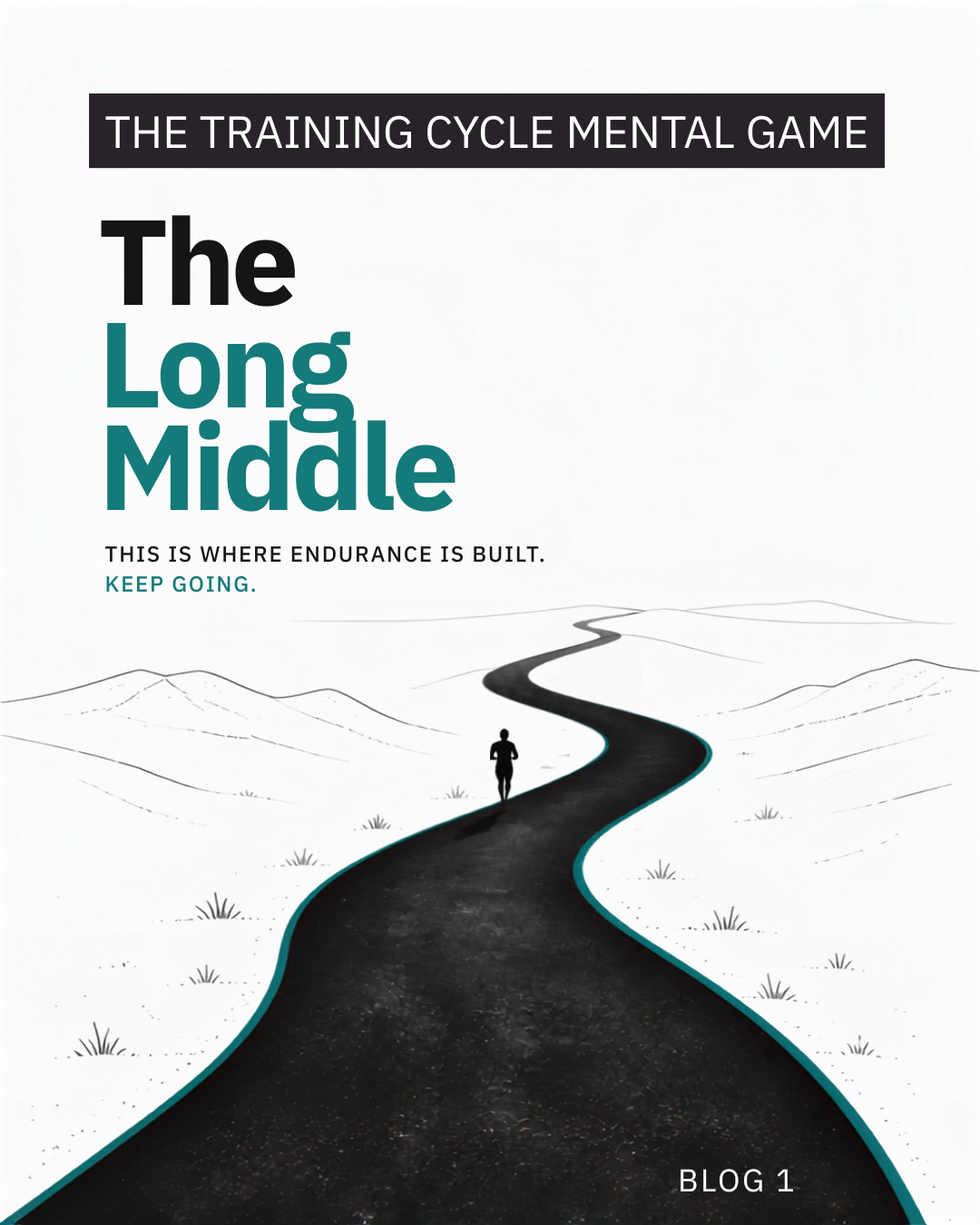
Part 1: The Long Middle, How to Stay Motivated When Nothing Feels Exciting
Welcome to the first part of The Training Cycle Mental Game. This series is written by Dr. Keirstyn, founder and chiropractor of Endurance Therapeutics. In this blog series we will discuss the mental work that happens between races and injuries, the everyday psychological load of being a training athlete when nothing feels urgent, exciting, or immediately rewarding. If you have ever felt unmotivated during base training, guilty about a missed workout, or mentally drained even when your body feels fine, this series is for you.
Part 1 starts with the hardest mental phase most athletes face, the long middle.
What the Long Middle Actually Is
The long middle is the stretch of training between the excitement of a new goal and the urgency of race week. It is base building. It is the weeks where the training plan says easy runs, strength work, and aerobic volume. It is the phase where nothing hurts, nothing feels broken, and nothing feels particularly exciting either.
For most athletes this is the phase where motivation quietly disappears. Not dramatically. Not in a way that makes you quit. Just enough that getting out the door feels harder than it should, and the training that used to feel purposeful starts to feel repetitive.
This is normal. And it is also one of the most important mental challenges to learn how to navigate, because the long middle is where the actual work gets done.
Why Motivation Dips During Base Training
The human brain is wired to respond to urgency and novelty. Race week has both. The long middle has neither. Base training is repetitive by design. The adaptations you are building, aerobic capacity, mitochondrial density, structural resilience, happen slowly and invisibly. There is no immediate feedback loop. No race result to chase. No dramatic improvement to celebrate.
The result is a motivation gap. You know the work matters. You understand why you are doing it. But it does not feel rewarding in the moment, and that makes it mentally harder to sustain.
Add to this the fact that most athletes are also managing work, family, and life logistics during this phase, and the training starts to feel like one more thing on the list rather than the thing you look forward to. The long middle is where the mental load of being a training athlete shows up most clearly.
Reframing the Work as Foundational, Not Boring
The shift that helps most athletes navigate this phase is reframing what the long middle actually is. It is not the boring part before the real training starts. It is the foundation that makes everything else possible.
The aerobic base you build now determines how well you handle the higher intensity work later. The strength and mobility work you do consistently during this phase is what keeps you healthy when training load increases. The mental discipline you develop by showing up when it does not feel exciting is what carries you through the hard moments on race day.
The long middle is not filler. It is the work that separates athletes who stay healthy and improve over years from athletes who chase intensity, get injured, and start over.
When I work with athletes in the clinic during this phase, the conversation is almost always about maintenance. Not because something is broken, but because this is the phase where we have time to address the small things before they become big things. Tight hip flexors. Glute activation that could be sharper. Thoracic mobility that limits your running mechanics under fatigue.
The athletes who use the long middle to stay on top of these details are the ones who make it through the higher intensity phases without breaking down. The long middle is where we build resilience, both physically and mentally.
Practical Strategies for Staying Engaged
Here is what actually helps when motivation dips during base training:
Anchor the work to process goals, not outcome goals. Outcome goals (race times, podium finishes) are too far away to feel motivating during the long middle. Process goals (hit every strength session this week, complete three easy runs at the right effort, show up for maintenance treatment) are immediate and controllable. They give you something to work toward every week, not just on race day.
Track the small wins. Base training does not produce dramatic improvements, but it does produce steady ones. Track your resting heart rate. Notice when a run that used to feel hard starts to feel easier. Pay attention to how your body feels during strength work. These are the signals that the work is paying off, even when it does not feel exciting.
Use the clinic strategically. The long middle is the best time to address the movement restrictions, compensation patterns, and tissue quality issues that will limit you later. Book a maintenance session. Get assessed. Use this phase to build the physical foundation that supports everything else. The athletes who do this consistently are the ones who stay healthy when training gets hard.
Build variety into the routine without abandoning the plan. Base training does not have to mean identical workouts every week. Change the route. Run with a different group. Add a trail run. Swap the order of your strength exercises. Small changes keep the work fresh without compromising the adaptations you are building.
Remember why you started. The long middle is where you prove to yourself that you are the kind of athlete who does the work even when it does not feel rewarding. That is the mental skill that shows up on race day when things get hard. The long middle is where you build it. Be sure to be comparing yourself to your past self and not others.
Up Next, The Missed Workout Spiral
Part 2 of The Training Cycle Mental Game tackles the catastrophizing that happens when life gets in the way of training. Why one missed workout feels like the end of everything, the all or nothing thinking that makes it worse, and how to separate a small disruption from a derailed plan. See you there.
Struggling to stay motivated during base training or wondering if the small things you are noticing need clinical attention? Book a free 15 minute phone consultation or a full assessment at Endurance Therapeutics. The long middle is where we help athletes build the foundation that lasts.
📍 Endurance Therapeutics | Oakville