

Blog 4: Stretching vs. Mobility: Why One Feels Good, One Makes You Better
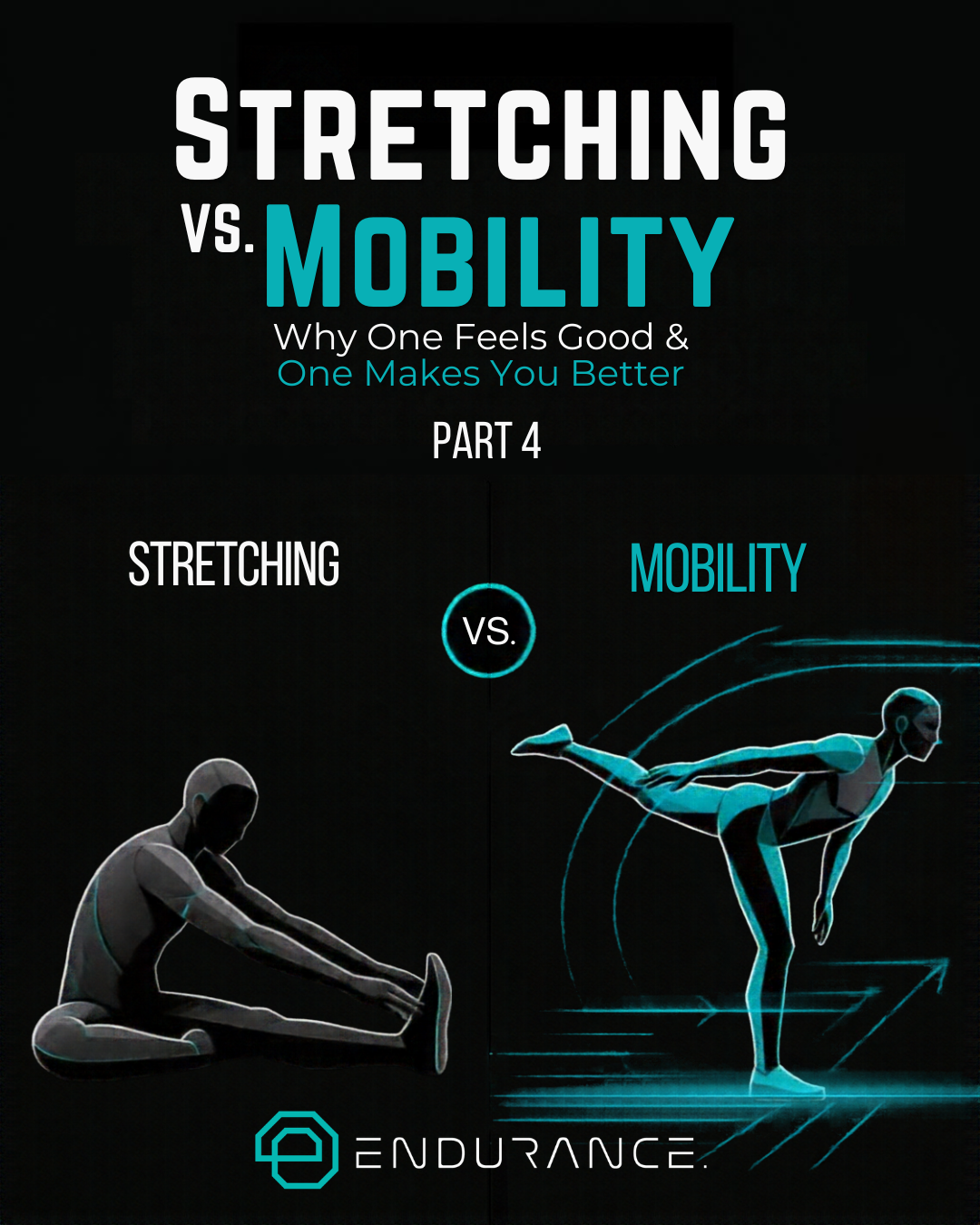
Part 4: Mobility for Racket Sports, Hockey, Soccer, and Court Athletes
Hi, I'm Dr. Keirstyn, founder, chiropractor and endurance coach at Endurance Therapeutics. In the first three parts of this series, we focused on endurance athletes: runners, cyclists, swimmers, and triathletes. Those athletes live in repetitive, linear movement patterns. Court and field athletes don't. If you play pickleball, padel, tennis, hockey, or soccer, your sport demands explosive power, quick direction changes, rotational control, and the ability to decelerate and change direction without your body falling apart. Those demands create completely different injury patterns than endurance sports, and they require different mobility work to address them.
In this part, we're breaking down what makes court and field athletes different, why you develop the injuries you do, and what mobility work actually addresses the demands of your sport.
What Makes Court and Field Athletes Different
Endurance athletes lose mobility because they live in repetitive, linear movement patterns. Court and field athletes lose mobility for a different reason: explosive, multi-directional movement without the foundational control to support it.
Here's what sets you apart:
Explosive, Multi-Directional Movement: You don't just move forward. You cut, lunge, rotate, and change direction at high speed. That creates massive forces through your hips, knees, ankles, and spine.
Rotational Power: Serving, shooting, and kicking all require rotational power through your hips and thoracic spine. If you don't have the mobility and control to rotate efficiently, your lower back takes over.
Deceleration and Landing Mechanics: Stopping, cutting, and landing create forces that are 2 to 3 times your body weight. If your body doesn't have the strength and control to handle those forces, your knees, ankles, and hips compensate.
Asymmetry: Racket sports, hockey, and soccer are all asymmetrical. You have a dominant side that does most of the work, and over time, that creates imbalances that lead to injury.
Those four factors create injury patterns that endurance athletes don't see. Lower back pain from rotational overload. Knee pain from poor deceleration mechanics. Hip impingement from asymmetry. Ankle sprains from poor landing control.
Mobility work for court and field athletes needs to address those specific demands, not just the same four areas we covered in Blog 3.
The Mobility Work Court and Field Athletes Actually Need
Here's what you need to focus on:
1. Rotational Control Through the Hips and Thoracic Spine
Serving, shooting, and kicking all require rotational power. That power comes from your hips and thoracic spine, not your lower back.
If your hips don't rotate, your lower back takes over. If your thoracic spine doesn't rotate, your lower back takes over. That's how you end up with lower back pain.
What you need:
Hip CARs with a focus on internal and external rotation: Move your hip through its full rotational range, slow and controlled. This teaches your nervous system that the range is safe and builds motor control at end range.
Thoracic CARs with a focus on rotation: Move your thoracic spine through rotation in both directions, slow and controlled. This builds rotational control and teaches your nervous system that the range is safe.
Half-Kneeling Chops and Lifts: Use a resistance band or cable and rotate through your thoracic spine while keeping your hips stable. This builds rotational strength and control under load.
Programming: 2 to 3 times per week, before or after training. CARs can be done daily as part of your warm up.
2. Deceleration and Landing Mechanics
Stopping, cutting, and landing create massive forces through your knees, ankles, and hips. If your body doesn't have the strength and control to handle those forces, your knees collapse inward, your ankles roll, and your hips compensate.
Deceleration isn't just about strength. It's about control. Your body needs to be able to absorb force eccentrically (while lengthening) and stabilize at end range.
What you need:
Single Leg Eccentric Step Downs: Stand on one leg on a step, lower your opposite heel toward the ground slowly over 3 to 5 seconds, and control the descent. This builds eccentric strength and control through your hip, knee, and ankle.
Lateral Lunges with a Pause: Step out to the side, sink into the lunge, and hold for 2 to 3 seconds before pushing back to the start. This builds hip and ankle control in the frontal plane, which is where most cutting and lateral movement happens.
Single Leg Balance with Perturbations: Stand on one leg and have a partner gently push you off balance in different directions. This trains your body to stabilize and react under load.
Programming: 2 to 3 times per week, as part of your strength training or warm up.
3. Managing Asymmetry
Racket sports, hockey, and soccer are all asymmetrical. You have a dominant side that does most of the work, and over time, that creates imbalances.
Your dominant side gets stronger and tighter. Your non-dominant side gets weaker and less coordinated. That imbalance creates compensations, and compensations lead to injury.
You can't eliminate asymmetry, but you can manage it.
What you need:
Unilateral strength work: Single leg squats, single leg deadlifts, and single arm presses. This builds strength and control on both sides and reduces the gap between your dominant and non-dominant side.
CARs on both sides: Even if one side feels better than the other, train both sides equally. This keeps your nervous system aware of the range on both sides and reduces the risk of compensation.
Rotational work in both directions: If you serve or shoot on one side, train rotational strength and control in both directions. This balances the load and reduces the risk of lower back pain.
Programming: 2 to 3 times per week, as part of your strength training.
4. Ankle and Hip Mobility for Cutting and Lunging
Cutting and lunging require ankle dorsiflexion (the ability to bring your shin forward over your toes) and hip internal rotation. If you don't have those ranges, your knee compensates by collapsing inward, and that's how you end up with knee pain, ankle sprains, and hip impingement.
What you need:
Ankle CARs: Move your ankle through dorsiflexion, plantarflexion, inversion, and eversion, slow and controlled. This builds motor control and teaches your nervous system that the range is safe.
Wall Ankle Mobilizations: Stand facing a wall, place one foot forward, and drive your knee toward the wall while keeping your heel on the ground. This builds dorsiflexion strength at end range.
90/90 Hip Switches: Sit on the ground with one leg in front (knee bent 90 degrees, externally rotated) and one leg behind (knee bent 90 degrees, internally rotated). Switch sides. This builds internal and external rotation strength at end range.
Programming: 2 to 3 times per week, before or after training. CARs can be done daily as part of your warm up.
How to Program Mobility Work Into Your Training
Mobility work doesn't need to take an hour. It needs to be consistent.
Here's how to fit it into your training:
Daily: CARs for hips, thoracic spine, and ankles (5 to 10 minutes total, part of your warm up)
2 to 3 times per week: Strength-based mobility drills (single leg step downs, lateral lunges, half-kneeling chops, unilateral strength work) as part of your strength training or cool down (10 to 15 minutes)
Mobility work is most effective when it's done consistently, not when it's crammed into one long session once a week. Small, frequent doses build motor control and teach your nervous system that the range is safe.
What Comes Next
Court and field athletes need mobility work that addresses the specific demands of their sport: explosive power, rotational control, deceleration, and asymmetry. If you've been dealing with lower back pain, knee pain, hip impingement, or ankle sprains, the problem isn't that you're not flexible enough. The problem is that your body doesn't have the strength and control to handle the ranges your sport demands.
In Blog 5, we're going to cover mobility for hockey players. Hockey creates its own unique set of restrictions because of the flexed, rotated position you spend hours in on the ice, and those restrictions lead to predictable injury patterns in your hips, lower back, groin, and shoulders.
If you've been dealing with tightness, compensations, or recurring injuries, book your session at Endurance Therapeutics today to identify what's actually restricting your movement and build a plan that creates lasting change.
📍 Endurance Therapeutics | Oakville, Ontario
📞 905-288-7161