

Blog 2: Activate Before You Train
Part 2: The Activation Exercises That Actually Make a Difference
Welcome back to Activate Before You Train. In Part 1 we covered what neuromuscular inhibition actually is, which muscles switch off most predictably in athletes, and why training an inhibited muscle delivers a fraction of the results you expect. Now we get into the practical side the activation exercises that work.
A quick note before we start: activation exercises are not the same as warm-up exercises and they are not the same as strength exercises. They are low-load, high-intention movements designed to establish a neurological connection with a specific muscle before you ask it to perform under load. The goal is not fatigue. The goal is recruitment.
Why I Am Focusing on the Glute Family
Across every sport I treat, the single most consistent activation deficit is in the glutes and hip stabilizers. Hockey players, runners, triathletes, golfers, masters athletes, and youth athletes all show the same pattern. The glutes are the engine of athletic performance and the most reliably switched off muscle group in the body.
Each of the five exercises below targets a slightly different aspect of glute and hip activation. Done together, they create a comprehensive activation routine that addresses the demands of almost every sport you can name. Done in isolation, each one delivers a specific neuromuscular benefit you should understand.
1. Hip Hikes
Stand sideways on a step or curb with one foot fully on the surface and the other hanging off the edge. Keeping the standing leg straight, slowly drop the hanging hip toward the floor, then drive it back up to level by squeezing the glute medius of the standing leg. The movement comes entirely from the hip, not the foot or the knee.
Why this matters:
Targets the glute medius in its most functional role, controlling pelvic drop during single-leg loading
This is exactly the pattern that fails during running, hockey skating, and any single-leg sport when the glute medius is inhibited
Direct application to preventing IT band syndrome, patellofemoral pain, and lower back issues that stem from hip drop mechanics
Slow, controlled tempo. Two seconds down, one second hold, two seconds up. Quality over quantity.
2. Standing Fire Hydrant
Stand tall with your hands on your hips or holding a wall for balance. Lift one leg out to the side with the knee bent at 90 degrees, mimicking the leg motion of a dog at a fire hydrant. Keep the trunk completely upright and resist any tilt toward the standing leg. Lower with control.
Why this matters:
Activates the deep external rotators of the hip alongside the glute medius. Muscles that are critical for hip stability but rarely targeted by standard warm-up routines
Trains hip abduction in a standing, weight-bearing position rather than on the floor, which transfers more directly to running and sport-specific movement
Builds the trunk control needed to keep the pelvis level when only one leg is loaded
Particularly valuable for hockey players where rapid lateral hip movement is constant
3. Glute Bridge
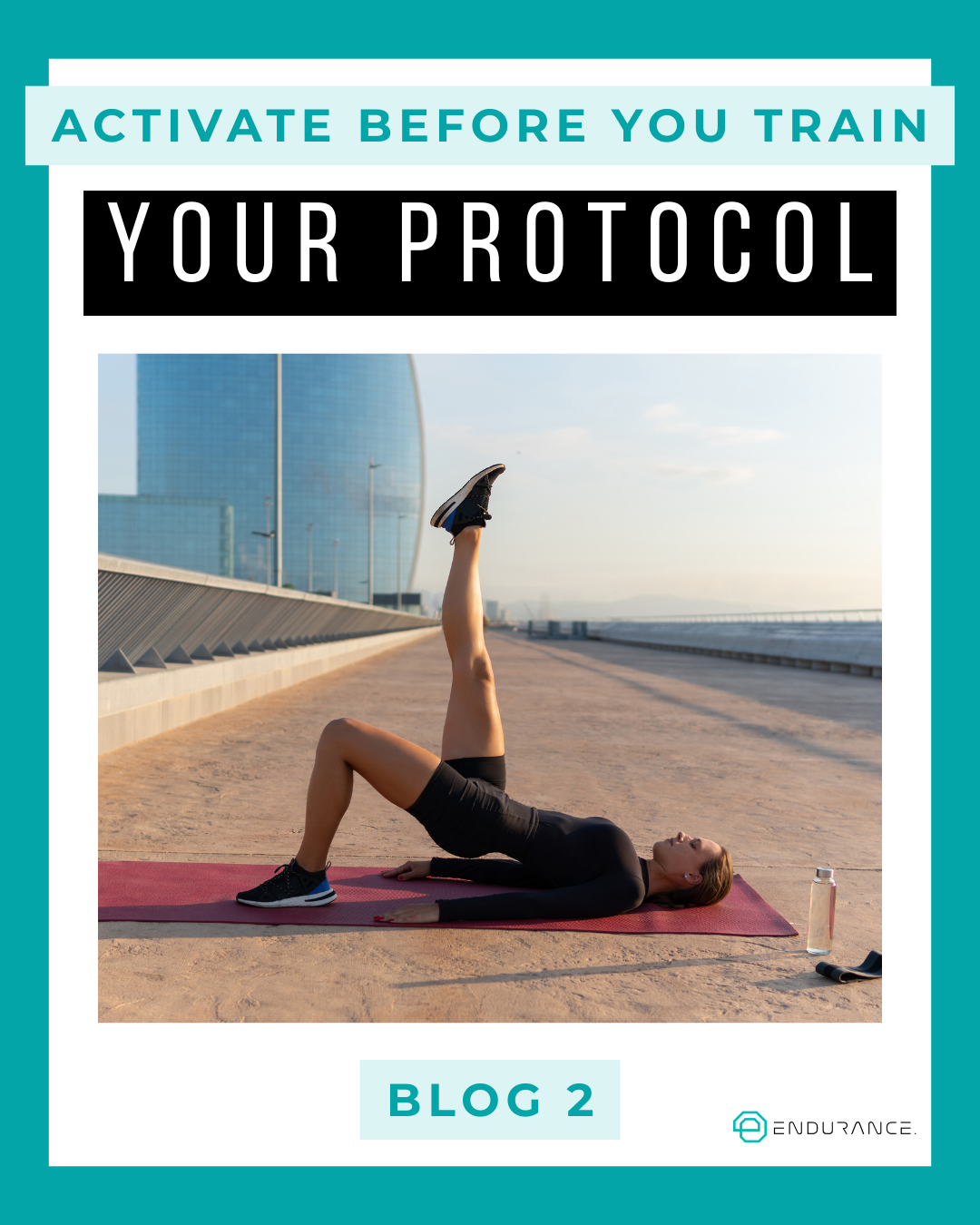
Lying on your back with knees bent and feet flat on the floor about hip-width apart, drive through the heels to lift the hips toward the ceiling. Pause at the top and actively squeeze the glutes for one to two seconds before lowering with control. If you feel this predominantly in your hamstrings, the glutes are inhibited — which is exactly the reason this exercise belongs in your activation routine.
Why this matters:
The foundational glute maximus activation exercise. Establishes the firing pattern of the largest muscle in the body
The hip extension pattern from the bridge mirrors the propulsive phase of running, skating, and cycling
The squeeze at the top is non-negotiable. That is where the neurological work actually happens
If your hamstrings or lower back take over, slow down, drive harder through the heels, and focus on the glute contraction specifically
4. Alternating Glute Bridge
Start in a glute bridge position with both feet on the floor and hips lifted. From the top of the bridge, lift one foot off the floor while maintaining the hip height, then return that foot to the floor and immediately lift the other. Alternate sides quickly while keeping the pelvis level and the hips elevated throughout. The challenge is to prevent any pelvic drop or rotation as the leg lifts.
Why this is one of the most underrated activation exercises:
This is the closest activation movement we have to mimicking the running gait cycle. Single-leg loading alternating rapidly while the pelvis maintains stability
Trains the glutes to turn on and off quickly in a reciprocal pattern, which is exactly what they need to do with every single running stride
Builds the neuromuscular firing speed that separates runners with good hip mechanics from those who run with chronic glute inhibition
Highlights asymmetries between sides. If one side drops or rotates more than the other, you have just identified a meaningful pattern to address
For runners specifically, this exercise is one of the highest-return movements in this entire series
5. Lateral Walks (Monster Walks)
Place a resistance band around the ankles or just above the knees and lower into a shallow squat position, keeping the trunk tall and the knees tracking over the toes. Step laterally with one foot, then bring the other foot to meet it without letting the band go slack. Move slowly and deliberately — do not allow the knees to collapse inward at any point. After 10 to 12 steps in one direction, reverse and walk back the other way.
Why this matters:
One of the most evidence-supported glute medius activation exercises in the rehabilitation and prehab research
The constant band tension keeps the glute medius firing throughout the entire movement, not just at peak contraction
Trains the muscle in a functional standing position with hip abduction under load, directly relevant to running, skating, and lateral sport movements
Building the knee-tracking pattern under band resistance carries over into proper knee mechanics during running and squatting
How Many Reps and Sets for Activation Work
This is where athletes often overcomplicate it. Activation work is not about fatigue accumulation. The parameters that work:
8 to 15 repetitions per exercise: enough to establish the neurological pattern without fatiguing the muscle before training begins
One to two sets per exercise: activation does not need volume, it needs intention
Slow and controlled tempo for most exercises: except the alternating glute bridge, where speed matters because you are training reciprocal firing
Light resistance only: bodyweight or a light band for lateral walks. Activation thresholds are low, heavy load defeats the purpose
Immediate progression to training: activation work should be done within five to ten minutes of the training session it is preparing for
Up Next: Building Your Practical Pre-Training Protocol
You know what to do. Part 3 of Activate Before You Train pulls it all together into practical, sport-specific pre-training protocols you can use from tomorrow. We will cover how long activation should take, how to sequence it, and how to adjust it based on your sport and what you are training that day. See you there.
______
Not sure which activation exercises are most relevant for your sport and your injury history? One session at Endurance Therapeutics gives you a clear picture of where your gaps are and a protocol built specifically around your movement patterns. Reach out to book your assessment with Dr. Keirstyn today.
📍 Endurance Therapeutics | Oakville