

Blog 3: Groin & Adductor Strains: The Injury Behind Your Hip and Knee Pain
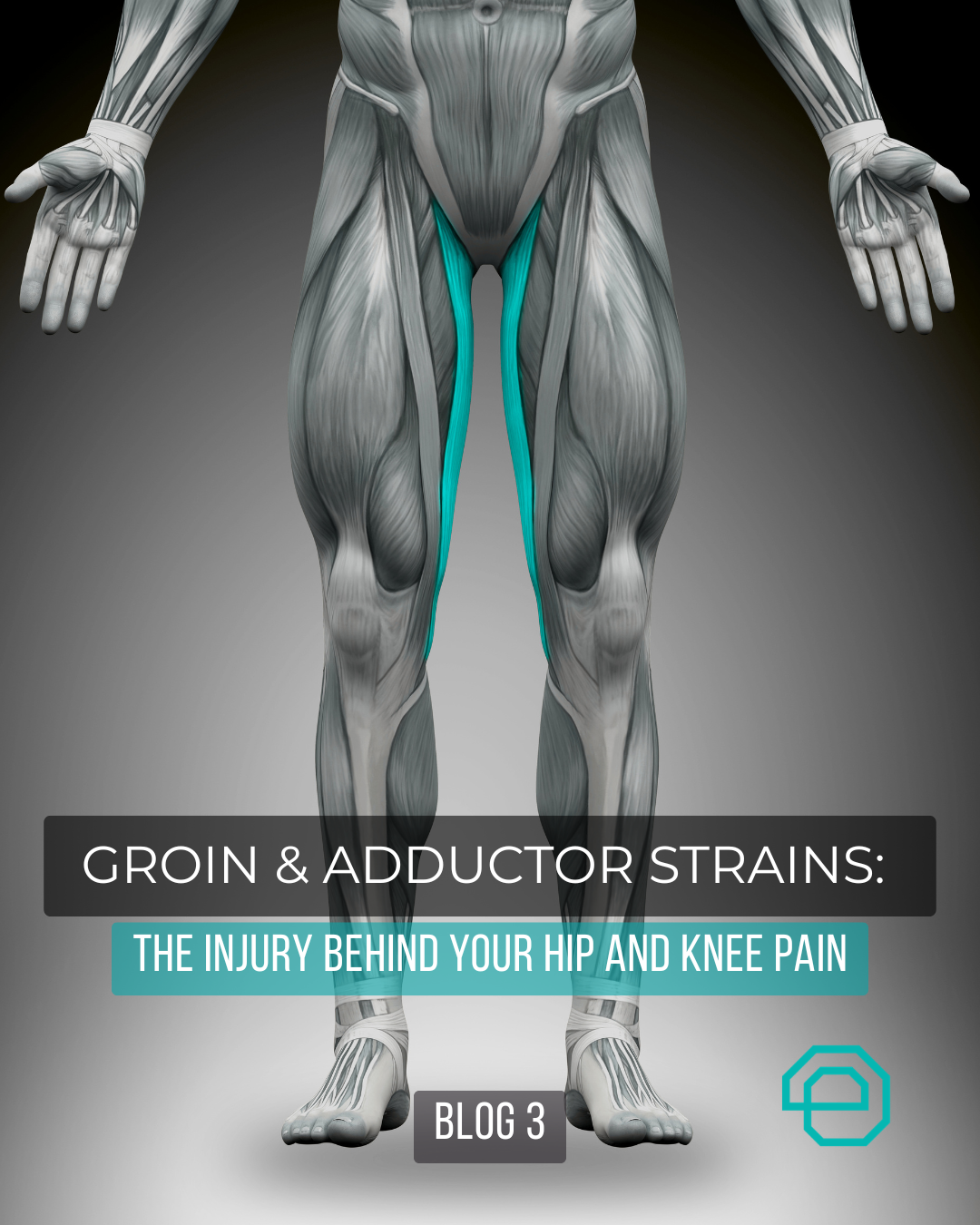
Part 3: Fixing Your Groin Strain, For Good!
Welcome to the final part of our groin and adductor series. In Part 1 we unpacked what these injuries actually are and why they cause hip and knee pain that throws everyone off. In Part 2 we covered exactly who gets them, why the imbalances behind them are so consistent, and why rest alone is never the full answer.
Now we get into what actually works, both for getting through this injury and for making sure it stays in the past.
What Recovery Actually Looks Like
The biggest mistake I see with adductor strains is treating them like a simple muscle strain that just needs time off. They do need a reduction in load, but complete rest without rehabilitation almost guarantees recurrence. Here's how I approach these injuries in practice:
Phase 1:
Reduce irritation without stopping movement. In the first few days after an acute strain, relative rest makes sense. But 'relative' is the key word. Gentle range of motion, isometric adductor holds (pressing knees together against a ball without movement), and soft tissue work to reduce protective tension all start here.
Phase 2:
Restore strength through a pain-free range. This is where most people skip straight to sport and where most recurrences begin. Progressive adductor loading, starting with low load and expanding range as tissue tolerance improves, is non-negotiable. Copenhagen plank progressions are one of the most evidence-supported exercises for this phase.
Phase 3:
Rebuild under sport-specific load. Lateral movements, change of direction, and eventually skating or running mechanics reintroduced gradually. The tissue needs to be tested under the actual demands it will face before return to full sport.
Phase 4:
Address the root cause. Hip stability, glute strength, hip flexor mobility, and movement pattern correction. Skip this and you're just waiting for the next episode.
What I Do in My Practice
Hands-on treatment plays an important supporting role not as the primary fix, but as the foundation that makes the rehabilitation work more effective. With adductor strains I typically use:
Soft tissue therapy:
This will reduce protective guarding in the adductors and surrounding hip musculature; the hip flexors, TFL, and glutes are almost always involved in compensation patterns. This includes active release techniques targeting the adductor longus attachment at the pubic bone, the most common site of tenderness and a key area to address for full recovery
Joint Mobilization of the Hip and Pelvis:
Restricted hip mobility is often a contributing factor that persists even after the muscle has healed
Movement Pattern Retraining:
In my clinic I like to call this functional movement training. Correcting the skating stride mechanics, running gait, or cutting patterns that created the overload in the first place
How Long Does It Take?
Honest answer — it depends on grade and how long the injury has been present:
Grade 1 (with proper management): 1 to 3 weeks
Grade 2: 4 to 8 weeks for return to full sport
Chronic/recurrent strains that have been under treated: often 8 to 12 weeks, because the tissue quality and surrounding weakness are more significant
The athletes who recover fastest are the ones who resist the urge to return the moment pain settles, and who complete the full progression rather than stopping at Phase 2.
Keeping It Away for Good
Prevention is where I put most of my energy with athletes who've had one of these injuries. The research is clear on what works:
Copenhagen Plank Progressions:
The single most evidence-backed exercise for adductor injury prevention in hockey players. A 2019 study in the British Journal of Sports Medicine found a significant reduction in groin injuries in hockey players who followed an 8-week Copenhagen protocol
Hip Abductor and Adductor Strength Balance:
This ratio matters. Neither side should be dramatically dominant
Glute Strength Maintenance:
This should be done year-round. Strong glutes mean the adductors aren't compensating for hip stability they shouldn't have to provide.
Proper Warm-Up:
Especially before explosive activity, especially in cold environments, the adductors need to be properly activated before skating pushes or sprinting
Load Management:
During mileage or intensity increases. Don't outrun your tissue's ability to adapt (remember the 10% rule here).
Regular Assessment and Maintenance:
Catching compensations early before they become injuries
Closing Words:
Groin and adductor injuries are not just a 'hockey player problem' or a 'runner thing.' They're a signal that the system supporting your hip isn't operating the way it should. Address that system, not just the symptom, and this injury becomes a one-time chapter rather than a recurring one.
That's a wrap on the Groin & Adductor series. If any part of this sounded familiar, don't wait for it to become a Grade 2 problem before doing something about it.
———
Groin strain that won't fully heal or keeps coming back? I work with athletes at every level to find the pattern behind recurring injuries and build a plan that actually addresses it. Reach out to book your assessment.
📍 Endurance Therapeutics | Oakville, Ontario
📞 905-288-7161